

Using Yield Calculation to Adjust Cost
© Frank Haluch 2011-2025
Many raw materials are bought by weight but are incorporated into finished products using a different unit of measure, such as pieces or inches. Therefore, a yield calculation needs to be performed to determine the real cost the material as it is arriving from a supplier.
Because the weight of a bundle of material is impacted by its actual dimension and density. It is important to verify a supplier’s “Density” compared to the published national standard, because density is the primary component of weight. [Search for "Density of Metals, All Common Metal Density Chart & Table PDF (theworldmaterial.com)"]
In the example below, “Supplier B” cost $1.57 per sheet or 3.3% more than “Supplier A,” even though Supplier B’s cost per pound is 7.7% lower!
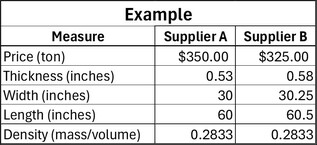
Supplier A
Theoretical Weight (lbs.) = 0.53 X 30.0 X 60.0 X 0.2833 = 270.27 lbs.
Cost per pound= $350.00 / 2,000 = $0.175 per lb.
Cost per sheet = $0.175 X 270.27 = $47.30
Supplier B
Theoretical Weight (lbs.) = 0.58 X 30.25 X 60.50 X 0.2833 = 300.72lbs.
Cost per Pound = $325.00 / 2,000 = $0.1625 per lb.
Cost per sheet = $0.1625 X 300.72 = $48.87
Go to Online Metal Weight Calculator for Metal Plate, Sheet, Bar, Pipe & Tube (theworldmaterial.com)
Having this type of data (density and dimensional accuracy) can lead to discussions about cost adjustments.
Sourcing is for Convergent Thinkers!