
Greedflation and Product Cost
© Frank Haluch 2011-2025
What is Greedflation?
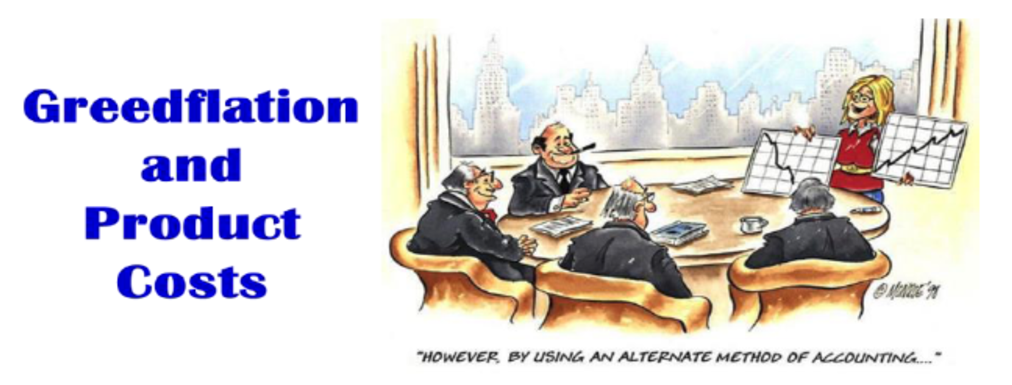
Greedflation is when companies add costs that are not associated with the cost of production; such as; fixed costs, research and development, product development. Groundwork Collaborative Think Tank has reported “corporate profits drove 53 percent of inflation during the second and third quarters of 2023” and quoted five companies “that bragged the ability to raise prices over the past two years, corporations have been explicit about how they’ve exploited their pricing power, and how they have and will continue to do so even as inflation comes down”. (Inflation Revelation: How Outsized Corporate Profits Drive Rising Costs - Groundwork Collaborative)
Who benefited from Greedflation?
“Growth of CEO compensation (1978–2021). Using the realized compensation measure, compensation of the top CEOs increased 1,460.2% from 1978 to 2021 (adjusting for inflation). Top CEO compensation grew roughly 37% faster than stock market growth during this period and far eclipsed the slow 18.1% growth in a typical worker’s annual compensation. CEO granted compensation rose 1,050.2% from 1978 to 2021.” (https://www.epi.org/publication/ceo-pay-in-2021/)
What is Overhead?
“Alexander Hamilton Church, clearly states the principle of overhead that he developed a long time ago. In his opinion overhead is a cost of production preparedness rather than a cost of production because overhead is a cost to maintain the plant in a condition ready to process whether there is work going on in the plant.” (Church's 1931 View of Overhead (maaw.info)
Financial Reporting
U.S. law requires publicly traded corporations must use Generally Accepted Accounting Practices (GAAP) when preparing their Financial Statements. GAAP requires companies to use the Absorption Accounting method which includes fixed costs as part of the Cost of Goods Sold (COGS). Absorption Accounting method is not a product costing method.
IRS Tax Reporting
There are anomalies/double dipping in COSG when comparing an Income Statement to IRS Form 1120 U. S. Corporation Income Tax Return because fixed costs are deducted twice. Once in the Income Section in line 2 Cost of goods sold are subtracted from line 1C Gross Receipts Profits. And again, in the Deductions Section line 20 –Depreciation along with many other non-product costs that suppliers include in their product costs; such as research & development, employee benefit programs, rents, and repairs and maintenance. (see 2023 Form 1120 (irs.gov) for 2023 IRS Form 1120)
What can Sourcing Do?
Suppliers can quote any price they wish, but Sourcing Professionals need to challenge the justification that fixed overhead and/or period costs are product costs. The following are sources of financial statements and pricing information: Search for Company Filings - Filings & Forms (sec.gov); Capacity Utilization and more - Manufacturing Databases, Tables & Calculators by Subject (bls.gov); Manufacturing - Categories - Production & Business Activity -- | FRED | St. Louis Fed (stlouisfed.org) where you can build a case that greedflation is at play. Any cost you believe is unethical i.e., is not a product cost is fair game to challenge suppliers. Example, service contracts that normally contain fully burden labor costs are double dipping because “Employee Benefits” are a fixed cost and tax deductible.
Email fhaluch@aol.com
Sourcing is for Convergent Thinkers!