

EXPERIENCE EFFECT FOR NEW PARTS
© Frank Haluch 2011-2025
Evaluate quotations for new parts using Experience Effect to reveal how much productivity is being passed on as volume increases. The drivers of productivity are labor efficiency, method improvements, technology driven learning, better use of equipment and product redesign. Published studies have documented, for example, an 18% productivity increase through the adoption Lean Six Sigma.
Bruce Henderson, of the Boston Consulting Group < Experience Curve - Overview, Origin, Graphical Representation (corporatefinanceinstitute.com) >, documented that experience curves/effect range between 10-30% each time production volume doubles. When a supplier’s quote is plotted on log-log graph, any slope greater than 90% needs to be question.
Experience curve is about capturing process knowledge. When a supplier makes a part for the for first time the goal is to make an acceptable part and then to repeat that process with ever increase productivity.
NASA quotes <Experience curve effects - Wikipedia> the following progress ratios in experience curves from different industries:
- Aerospace: 85%
- Complex machine tools for new models: 75–85%
- Repetitive electronics manufacturing: 90–95%
- Repetitive machining or punch-press operations: 90–95%
- Repetitive welding operations: 90%
- Raw materials: 93–96%
- Purchased parts: 85–88%
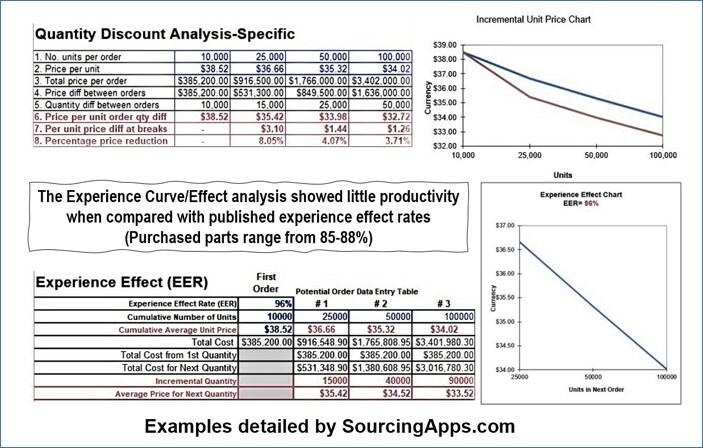
The above Experience Effect analysis was calculated using Sourcingapps (currently not available) and MS Excel Goal Seek from an actual quote. The first price and quantity were entered. And, then the experience effect rate was calculated using the last price in the quotation and MS Excel Goal Seek. In this case the supplier pricing represented an Experience Curve/Effect of 96%.
Pair this with a QDA analysis that showed a “ski slope” which can mean that either the seller may have started with artificially high price to show a steep discount or the supplier has factored in in productivity. So, using 88% experience effect rate for purchased parts the cost for 100,000 units would be $24.19. This would be a good place to start the negotiations.
Sourcing is for Convergent Thinkers!